

SFP stands for “small form-factor pluggable”, and “transceiver” refers to a device that can both transmit and receive data. An SFP transceiver is a compact, hot-swappable device that plugs into a physical port on a network device. SFP modules are used in communication networks and have a transmitting side (Tx) and a receiving side (Rx). The transceiver contains a laser that communicates with the receiving side of the optics at the other end.
SFP optics are designed to support multiple communication standards, including SONET, Gigabit Ethernet, and Fibre Channel. SFP interfaces on network devices such as routers provide a modular interface that can easily be adapted to fiber-optic and copper network requirements.
MiniGBIC
SFP is also known as miniGBIC. GBIC stands for Gigabit Interface Converter (another transceiver form factor), and since SFP is smaller than GBIC, it is therefore referred to as miniGBIC. SFP was introduced later than GBIC and serves the same purpose as the GBIC module, but due to its smaller size, SFP has replaced GBIC in most applications today.
SFP typically comes with LC connectors (Lucent connectors), unlike GBIC, which typically comes with SC (Standard connectors). To clarify: LC and SC connectors are fiber-optic cable connectors, differentiated by their size.
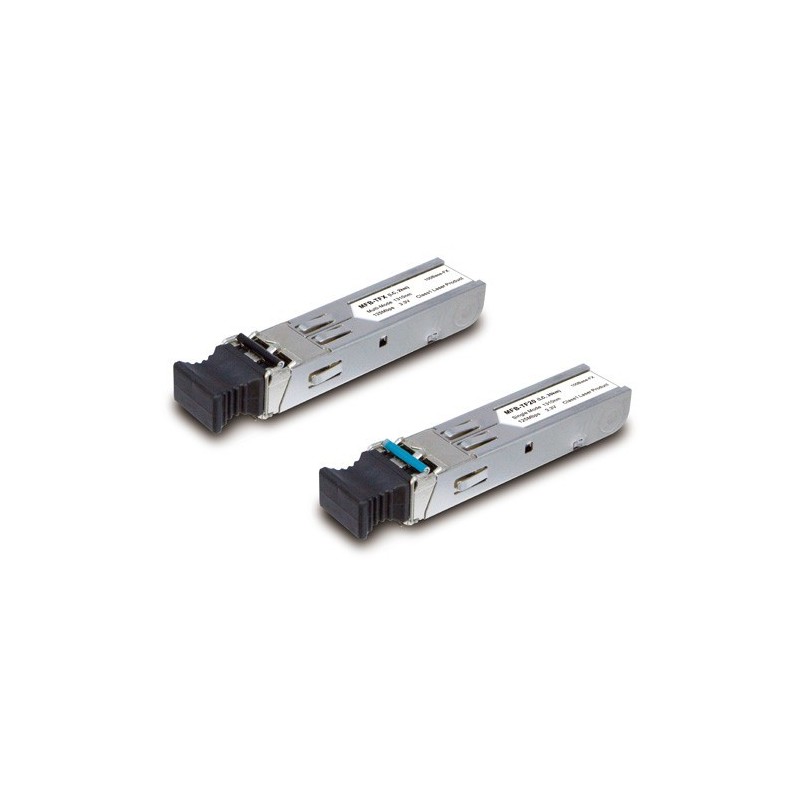
Single-Mode SFP vs Multi-Mode SFP
SFP transceivers can work with different types of optical fiber. SFP optics that operate with single-mode fiber are called single-mode SFPs, and those that operate with multi-mode fiber are known as multi-mode SFPs.
Single-Mode SFP
Single-mode fiber (SMF) has a smaller core (9 µm) and a narrow wavelength path. This means SMF carries higher bandwidth and can reach longer transmission distances. SMF SFPs primarily operate at 1310 nm and 1550 nm wavelengths and can reach distances from 2 km to 120 km.
Multi-Mode SFP
Multi-mode fiber (MMF) uses a much larger core (62.5 µm and 50 µm) and a wider light path. MMF SFPs are used for short-distance transmissions up to 500 m, and optics used with MMF are less expensive. MMF SFPs operate at an 850 nm wavelength. Although it cannot carry signals over long distances, it can carry many types of optical signals.
News: 2.5Gbps SFP
SFP modules support speeds from 100 Mbit per second (Mbps) up to 100 Gbps. The most common type used today is 1000 Mbps (1 Gbps). They are cost-effective, and 1 Gbps is sufficient for most networks. A new type is now on the market: 2.5 Gbps, which provides higher data rates. It has the same physical dimensions, but it is important that switches and media converters support this 2.5 Gbps SFP module. They are available as Multi-Mode (300 meters) and Single-Mode (up to 20 km). They are also available for simplex fiber cables (with only one core); these are called WDM SFP modules. They use two wavelengths on the same fiber (1550 / 1310 nm).